Configuring apps with compilation environment declarations
Learn about using compilation environment declarations to customize application behavior.
You can specify compilation environment declarations when building or running a Dart application. Compilation environment declarations specify configuration options as key-value pairs that are accessed and evaluated at compile time.
Your app can use the values of environment declarations to change its functionality or behavior. Dart compilers can eliminate the code made unreachable due to control flow using the environment declaration values.
You might define and use environment declarations to:
- Add functionality during debugging, such as enabling logging.
- Create separate flavors of your application.
- Configure application behavior, such as the port of an HTTP server.
- Enable an experimental mode of your application for testing.
- Switch between testing and production backends.
To specify an environment declaration when running or
compiling a Dart application, use the
--define option or its abbreviation,
-D. Specify the declaration key-value pair
using a <NAME>=<VALUE> format:
dart run --define=DEBUG=true -DFLAVOR=free
To learn how to set these declarations with other tools, check out the specifying environment declarations section in this guide. That section explains the declaration syntax and how to specify them on the command line and in IDEs and editors.
Accessing environment declarations
#
To access specified environment declaration values, use one
of the fromEnvironment constructors with
const or within a constant context. Use
bool.fromEnvironment
for true or false values,
int.fromEnvironment
for integer values, and
String.fromEnvironment
for anything else.
Each of the fromEnvironment constructors
require the name or key of the environment declaration. They
also accept an optional defaultValue named
argument to override the default fallback value. The default
fallback value is used when a declaration isn't defined or
the specified value cannot be parsed as the expected type.
For example, if you want to print log messages only when the
environment declaration DEBUG is set to
true:
void log(String message) {
  // Log the debug message if the environment declaration 'DEBUG' is `true`.
  // If there was no value specified, do not log.
  if (const bool.fromEnvironment('DEBUG', defaultValue: false)) {
    print('Debug: $message');
  }
}
In this snippet, if DEBUG is set to
false
during compilation, or not specified at all, production
compilers can completely remove the condition and its body.
The fromEnvironment constructors fallback to a
default value when the declaration isn't specified or the
specified value cannot be parsed. Therefore, to specifically
check whether an environment declaration has been specified,
use the
bool.hasEnvironment
constructor:
if (const bool.hasEnvironment('DEBUG')) {
  print('Debug behavior was configured!');
}
Specifying environment declarations
#Dart CLI
#
Both dart run and the
dart compile subcommands accept any number of
the -D or --define options to
specify environment declaration values.
dart run --define=DEBUG=true -DFLAVOR=free main.dart
dart compile exe --define=DEBUG=true -DFLAVOR=free main.dart
dart compile js --define=DEBUG=true -DFLAVOR=free main.dart
dart compile aot-snapshot --define=DEBUG=true -DFLAVOR=free main.dart
dart compile jit-snapshot --define=DEBUG=true -DFLAVOR=free main.dart
dart compile kernel --define=DEBUG=true -DFLAVOR=free main.dart
webdev
#
To learn about configuring webdev to pass
environment declarations to both the development and
production web compilers, check out
the webdev configuration documentation.
Visual Studio Code
#
In your launch configuration (launch.json)
under configurations, add a new
toolArgs key containing your desired
environment declarations:
"configurations": [
    {
        "name": "Dart",
        "request": "launch",
        "type": "dart",
        "toolArgs": [
          "--define=DEBUG=true"
        ]
    }
]
To learn more, check out the documentation for VS Code launch configurations.
JetBrains IDEs
#In the Run/Debug Configurations for your project, add your desired environment declarations to VM options:
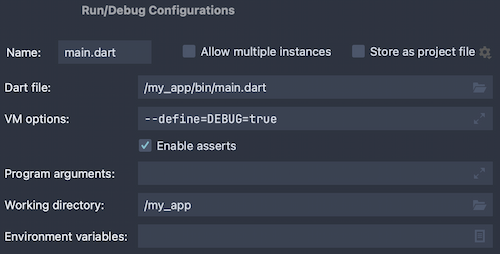
To learn more, check out JetBrains' documentation for Dart Run/Debug Configurations.
Flutter
#
To specify environment declarations to the Flutter tool, use
the --dart-define option instead:
flutter run --dart-define=DEBUG=true